

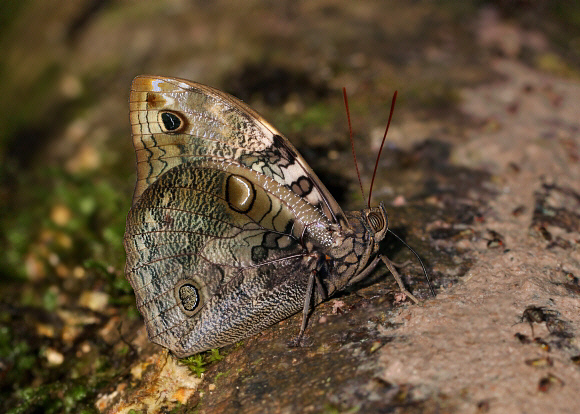
 Opsiphanes invirae agasthenes, Satipo, Peru – Adrian Hoskins
Introduction
The Morphinae comprises of about 140-150 neotropical species, of which 93 are included within the tribe Brassolini. Of these 73 are placed in the Brassolina – a subtribe including the genera Brassolis, Blepolenis, Caligo, Caligopsis, Catoblepia, Dasyophthalma, Dynastor, Mielkella, Eryphanis, Penetes, Mimoblepia, Opoptera, Opsiphanes, Orobrassolis and Selenophanes. All Brassolines are crepuscular or nocturnal in behaviour, although a few species also fly by day in the darkest areas of the forest.
The genus Opsiphanes comprises of 11 species distributed variously from Mexico to Paraguay and Argentina. The butterflies are characterised by having a stout thorax and abdomen, large eyes and sturdy antennae. The costa is strongly curved, and the forewing termen is slightly concave. In all species the upperside wings are dark brown in colour with a diagonal orange or yellowish band on the forewings. The undersides are an earthy brown hue. There are dark striations on the outer half of the wings, and heavy marbling at the base. On the hindwings there is a prominent ocellus within which there is a white crescent, and there is a smaller almost circular ocellus near the tornus.
Opsiphanes invirae occurs in central America from Honduras to Panama. In South America it occurs east of the Andes from Colombia to Paraguay. There are 13 named subspecies.
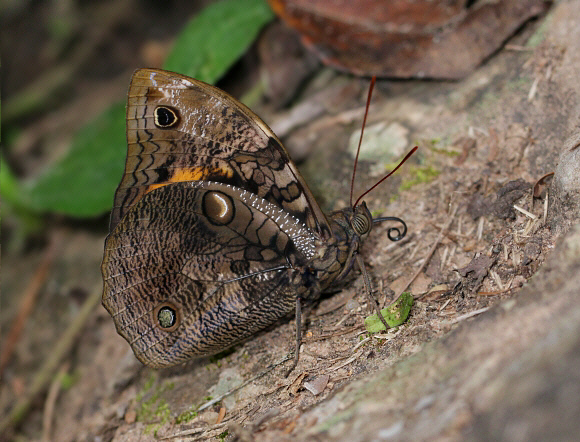 Opsiphanes invirae agasthenes, Satipo, Peru – Adrian Hoskins
Habitats
This species is found in primary and secondary rainforest, at altitudes up to about 1000m.
Lifecycle
The egg is globular, and is laid singly, typically on the stems or dead leaf blades of the foodplants, which include Cocos eriospatha, Livistona australia, L.rotundifolia and Arecastrum romanzoffianum, ( Arecaceae ). The caterpillar feeds nocturnally. When fully grown it is yellow-green with dark green and reddish lateral and dorsal lines. The head is dark green and has 4 short backward projecting reddish horns. The larvae are parasitised by the Braconid wasp Apanteles biezankoi. The chrysalis is light green, marked with gold spots on the sides.
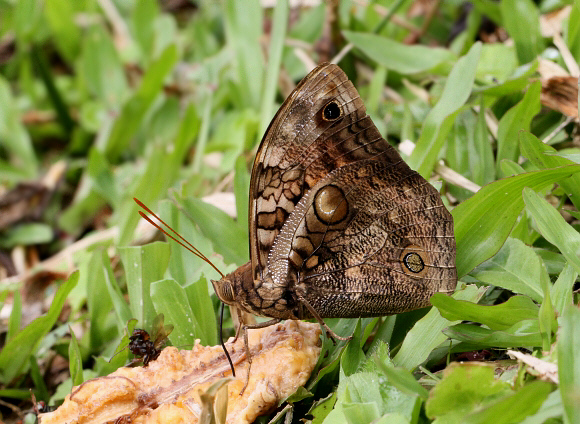 Opsiphanes invirae sticheli, Tatama NP, Colombia – Adrian Hoskins
Adult behaviour
Opsiphanes fly mainly at dusk and dawn. They are usually encountered in two’s and three’s in the company of Eryphanis, Selenophanes, Narope, Prepona and Memphis species, feeding at rotting fruit on the forest floor. They also feed at decomposing fruit in the canopy, and occasionally at peccary dung or urine.
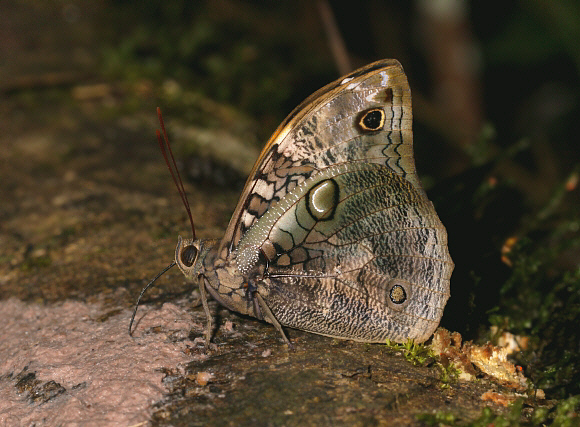
Opsiphanes invirae agasthenes, Satipo, Peru – Adrian Hoskins